


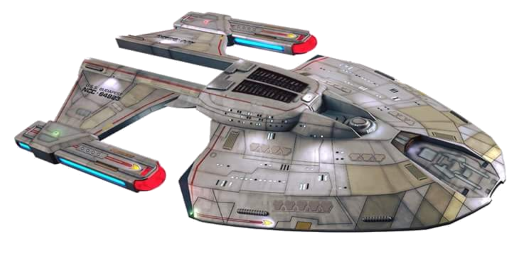
USS Boudicca is a Norway class starship. She has been in service since 2390 and is currently commanded by Captain Selena Blonder.
Length: 445.02 meters
Width: 275.24 meters
Height: 64.00 meters
Weight: 758,840 Metric Tonnes
Cargo Capacity: 32,200 Metric Tonnes
Hull: Duranium-Tritanium composite
Number of Decks: 17 Total, 16 Habitable.
Tactical Systems
PHASER ARRAYS
Phaser Array Arrangement: Two small dorsal phaser arrays located in the hull depression at the bow of the ship. Two ventral phaser arrays on the primary hull, extending from the very back of the primary hull almost to the bow. These arrays also converge gradually as they approach the widest part of the primary hull, converging near the bow. Two phaser strips are located on either side of the primary hull nearest to the rear and high on the dorsal side to cover the rear-firing arc.
Phaser Array Type: Even though the Norway Class is a medium sized vessel, it still utilizes the Type X array system. The six arrays are all Type-X, the new standard emitter. Each array fires a steady beam of phaser energy, and the forced-focus emitters discharge the phasers at speeds approaching .986c (which works out to about 182,520 miles per second – nearly warp one). The phaser array automatically rotates phaser frequency and attempts to lock onto the frequency and phase of a threat vehicle’s shields for shield penetration.
Phaser Array Output: Each phaser array takes its energy directly from the impulse drive and auxiliary fusion generators. Individually, each type X -emitter can only discharge approximately 5.1 MW (megawatts). However, several emitters (usually two) fire at once in the array during standard firing procedures, resulting in a discharge approximately 10.2 MW.
Phaser Array Range: Maximum effective range is 300,000 kilometers.
TORPEDO LAUNCHERS
Arrangement: Two fixed-focus torpedo launchers, one located just below the main deflector dish on the dorsal side of the Primary Hull and another at the rear of the primary hull. The Norway Class is fitted with smaller versions of the Burst-Fire Torpedo launcher originally developed for the Sovereign class starship. The Norway can fire 3 torpedoes per salvo from each launcher, with a maximum rate of fire of 6 torpedoes from both launchers.
Type: Type-6, Mark-XXV Photon, Quantum & Transphasic Torpedoes capable of pattern firing (Sierra, Delta, etc.) as well as independent launch.
Range: Maximum effective range is 3,500,000 kilometers.
Defense Systems
SHIELD SYSTEMS
Type: Symmetrical peristaltic subspace graviton field. This type of shield is similar to those of most other Starships, but rated higher than most vessels of equivalent size as a defensive measure due to its role in hosting conferences and ferrying VIPs. Other than incorporating the now mandatory nutational shift in frequency, the shields alter their graviton polarity to better deal with more powerful weapons and sophisticated weaponry (including Dominion, Breen, and Borg systems).
During combat, the shield sends data on what type of weapon is being used on it, and what frequency and phase the weapon uses. Once the tactical officer analyzes this, the shield can be configured to have the same frequency as the incoming weapon – but different nutation. This tactic dramatically increases shield efficiency.
Output: There are 16 shield grids on the Norway Class, and each one generates 160 MW, resulting in total shield strength of 2,560 MW. The power for the shields is taken directly from the warp engines and impulse fusion generators. If desired, the shields can be augmented by power from the impulse power plants. The shields can protect against approximately 42% of the total EM spectrum (whereas a Galaxy Class Starship’s shields can only protect against about 23%), made possible by the multi-phase graviton polarity flux technology incorporated into the shields.
Range: The shields, when raised maintain an average range of 30 meters away from the hull.
Engineering Systems
WARP PROPULSION SYSTEM
Type: A-Grade Standard Matter/Anti-Matter Reaction Drive, developed by Ceries Industries. Information on this Warp Drive can be found in any Starfleet Library or Omnipedia.
Normal Cruising Speed: Warp 7.5
Maximum Speed: Warp 9.9 for 22 hours
IMPULSE PROPULSION SYSTEM
Type: The Corps of Engineers considered standard Norway Class Impulse Engines ‘excessive’, providing thrust far in excess on the highest estimated needs. Developed and built by Slepnir Inc., the Norway Class engines can be ‘temperamental’ with the tendency to over steer due to the huge thrust factor in Real Space travel. However, the ability to produce so much power effectively diminishes inertial drag making the Norway Class vessel more agile in Real Space.
Output: Each engine (there are two impulse engines) can propel the Norway Class at speeds just under .25c, at “Full Impulse” and an upper ceiling of .75c at three quarters the speed of light. Generally, Starfleet Vessels are restricted to .25c speeds to avoid the more dramatic time dilation effects of higher relativistic speeds. However, such restrictions can be overridden at the behest of the ship’s captain.